

ABOUT
This guide is designed for foreign companies considering entry into the Okinawa market.
It explains how to prepare a business plan required for consultation, support programs, and discussions with local stakeholders.
A business plan should include elements such as a business overview, market analysis, business model, operational structure, and schedule. It is crucial that the content be concrete and data-driven. Furthermore, clearly articulating the management vision helps unify internal consensus and establish the team’s direction. Creating a solid business plan increases the likelihood of success and enables sustainable growth.
Basic Structure of a Business Plan
How to Write a Business Plan
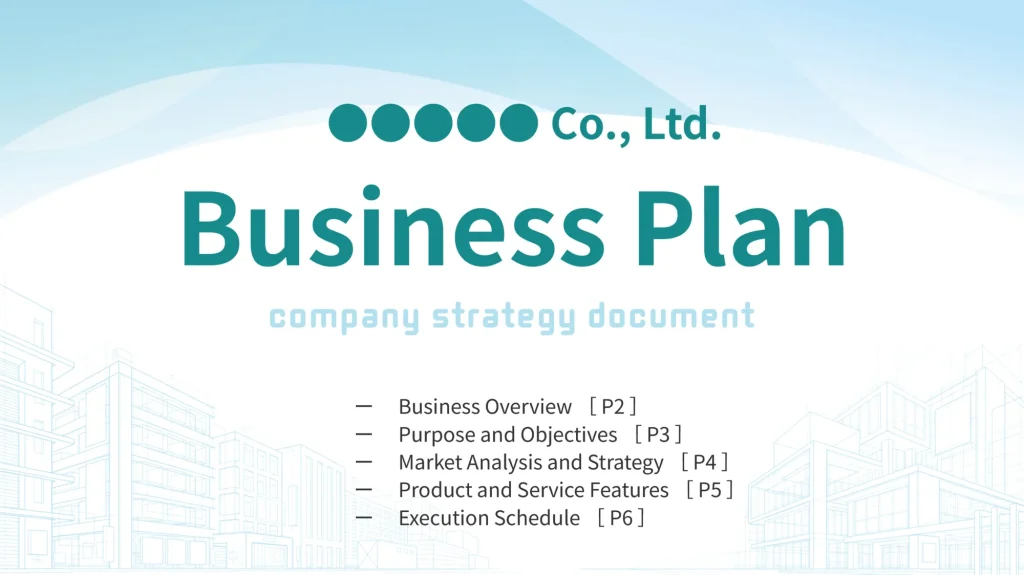
The business plan should be structured in the following order: ① Business Overview, ② Objectives and Goals, ③ Market Analysis and Strategy, ④ Product/Service Features, ⑤ Implementation Schedule. It is crucial to include clear objectives and substantiated data to communicate effectively to investors and stakeholders.
Business Overview
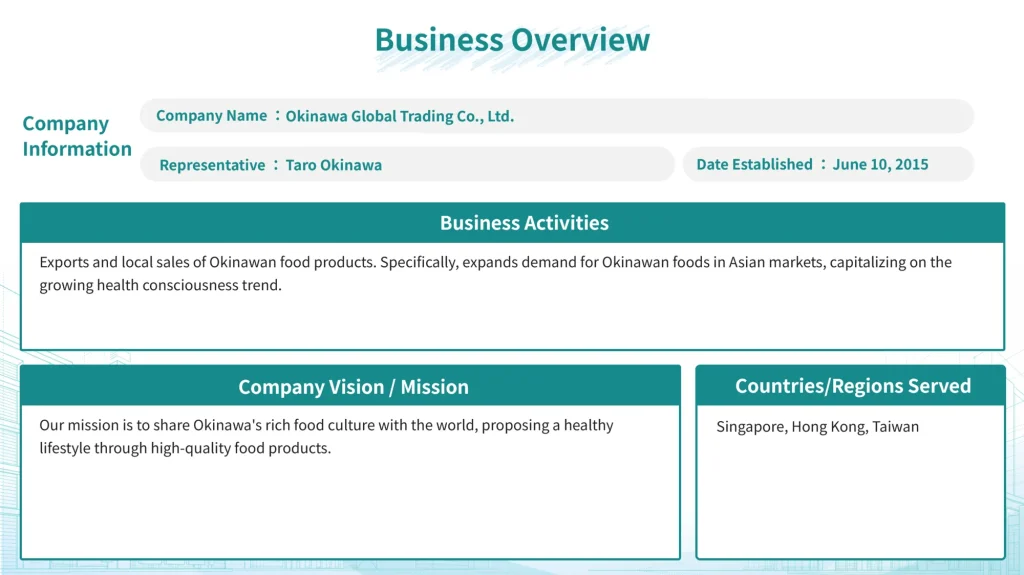
Company Information
Company Information includes the “Company Name,” “Representative’s Name,” and “Date of Establishment.”
Business Activities
This section describes the business and service content, concept, target audience, and other details. It provides a clear and concise explanation of who this business serves, what it offers, and how it delivers those offerings.
Company Vision / Mission
The vision represents the “future we aim for,” while the mission represents the “purpose we must fulfill.” It is crucial to clearly articulate the business’s raison d’être and contribution to society, expressing it concisely and concretely in a way that resonates with stakeholders.
Countries and Regions for Business Expansion
Specify the names of countries and regions where you wish to expand your business operations.
Purpose and Goals
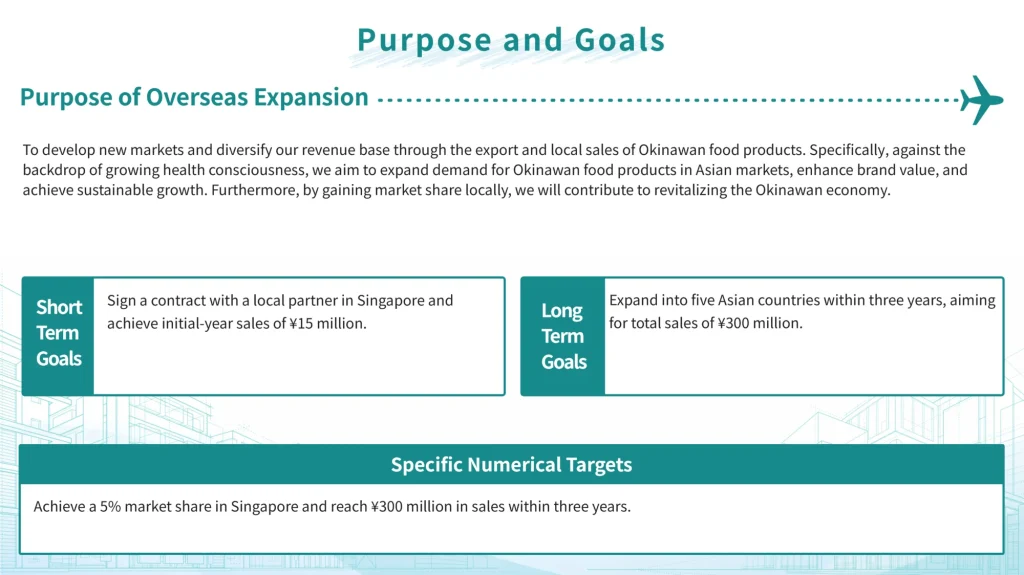
Purpose of Overseas Expansion
Clearly state the objective of securing new revenue streams through entry into overseas markets, aiming to expand business scale and enhance brand value.
Short-Term Goals
Briefly summarize goals to be achieved within 1 to 2 years.
Long-Term Goals
Outline objectives such as increasing the overseas sales ratio, establishing a stable revenue structure, and expanding brand recognition within a period of five years or longer.
Specific numerical targets
Sales revenue, number of customers, number of locations, overseas market share, and other metrics shall be explicitly stated as indicators for target achievement.
Specific numerical targets should be measurable.
Market Analysis & Strategy
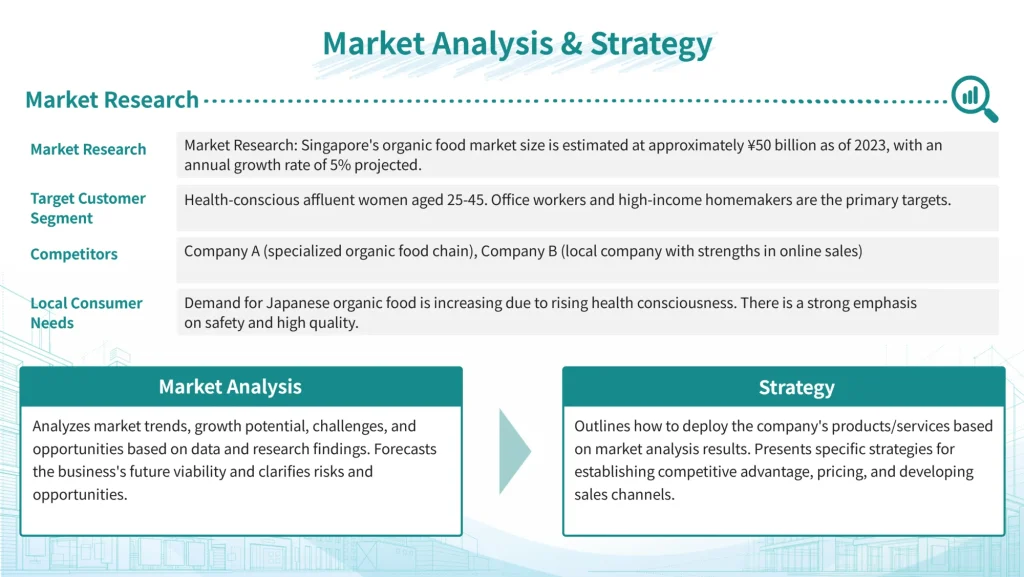
Market Size
This section explains the size, growth potential, and future prospects of the target market based on data. Understanding local market size is a key indicator showing the growth potential and profitability of a business.
Target Customer Segment
Define attributes such as age, gender, occupation, and lifestyle to specify which demographic your products or services will serve.
Concretely defining your customer profile enhances the precision of your strategy.
About Competitors
Analyze competitors’ business activities, market share, strengths, and weaknesses to clearly define our company’s competitive advantages.
Understanding the competitive landscape enables the formulation of differentiation strategies.
Local Consumer Needs
We analyze the products and services demanded by consumers in the local market, their purchase motivations, and buying behaviors to identify customers’ latent needs.
This enables us to maximize the value we deliver.
Market Analysis
We analyze market trends, growth potential, challenges, and opportunities based on data and research findings. We forecast the future viability of the business and clarify risks and opportunities.
Strategy
Based on market analysis results, clearly state how to deploy the company’s products and services.
Outline specific strategies such as establishing competitive advantages, pricing, and developing sales channels.
Product/Service Features
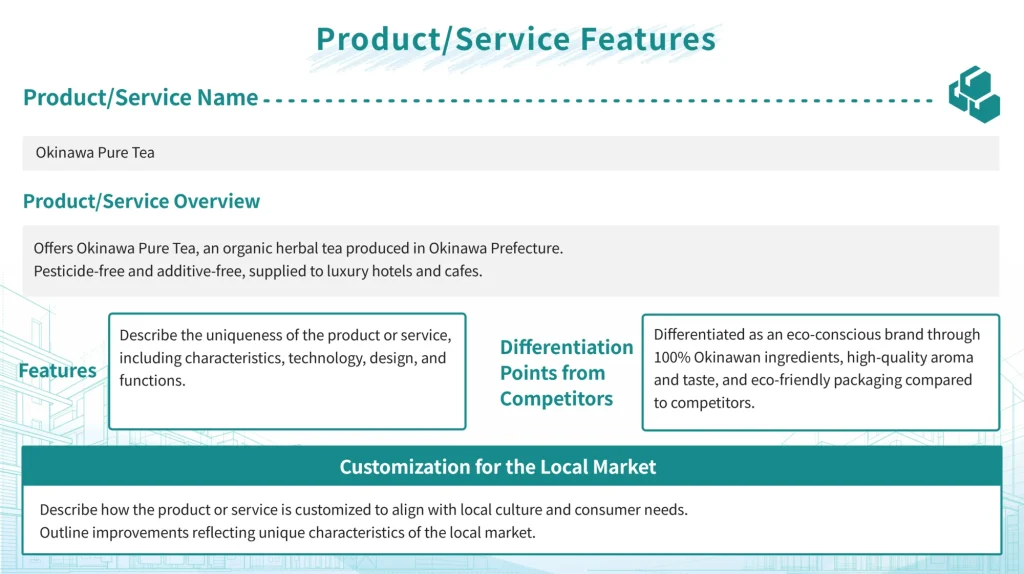
Product/Service Name
Enter the name of the product or service being offered. Choose a name that is concise, easy to understand, and resonates with the target audience.
This may include brand names or trademarks.
Product/Service Overview
This section explains the fundamental details, purpose, and value provided by the product or service.
Briefly describe what needs it fulfills and what problems it solves.
Features
Emphasizes the uniqueness of products or services, including their characteristics, technology, design, and functions.
Specifically outlines appealing points and benefits for customers to differentiate them from competitors.
Key Differentiators from Competitors
Clearly state how your products or services outperform competitors.
List differentiating factors such as quality, price, features, and customer support.
Customization Details for the Local Market
This section describes how products and services are customized to align with local culture and consumer needs.
It outlines improvements reflecting characteristics unique to the local market.
Implementation Schedule
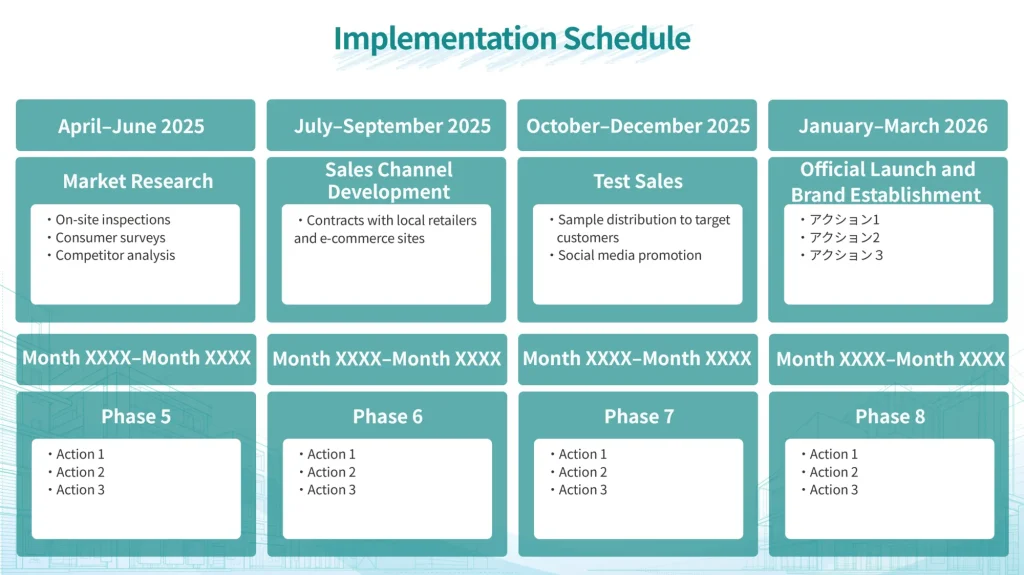
Each Phase
The execution schedule outlines the project’s key phases and their progress. Set the duration for each phase.
Specific Actions
This section details the specific activities to be implemented in each phase. It clearly outlines the goals to be achieved and action plans for each stage along a timeline. This demonstrates the concrete flow of plan execution.
Business Plan Template Download
After filling out each field and submitting the form, you will be able to download the original business plan template.
